Conference and meeting rooms
Table tops and edges, chair arms and bases, glass partitions and the floor under the table. These rooms sit unused for days then host a client meeting, so they are reset before use rather than only on a fixed rotation.
Serving Des Moines, Iowa & surrounding areas
Commercial cleaning in Johnston
Commercial cleaning for Johnston professional offices, clinics, financial and institutional tenants, where client-facing space is held to a presentation standard and after-hours entry follows building protocol.
Client-facing space
Professional offices do not generate much soil. A law practice, an accounting firm, an advisory office or a clinic produces a fraction of what a restaurant or warehouse does. What they have instead is scrutiny: clients sit in the conference room for an hour looking at the table edge, the glass, the carpet seam and the baseboard. The standard is visual, and it is unforgiving in a way that a dirtier building never is.
The second thing that shapes the work here is access. These tenants usually want cleaning done after hours, often inside a managed building with its own entry rules, alarm procedures and expectations about who is in the space unsupervised. We work from 1800 Dixon St, Suite 4 in Des Moines, and for this kind of client the arrangement matters as much as the task list: a small assigned crew, a documented route, and advance notice before anyone unfamiliar is in your suite.
If you are comparing providers, start by looking for three things: a written scope that matches your space, a schedule that protects productivity—before hours, after hours, or low-traffic windows—and a plan for floors. Floors show wear fast in Iowa winters and wet spring days, and they are usually the first place a “quick clean” falls short.
For businesses that need help beyond office environments, our team also handles broader commercial cleaning services in Des Moines with the same approach: define the scope, set the routine, then verify the results.
Where attention goes
Table tops and edges, chair arms and bases, glass partitions and the floor under the table. These rooms sit unused for days then host a client meeting, so they are reset before use rather than only on a fixed rotation.
Entry glass and door hardware, the reception counter, seating including upholstery seams, side tables and the floor and matting inside the door. This is the first impression, and it is the part most visitors spend time looking at.
Hard surfaces, chair bases, window sills, interior glass and floors, cleaned around whatever is on the desk. Papers, files and client material are never moved, stacked or straightened, and the scope states that explicitly.
Fixtures, mirrors, dispensers, partitions and floors cleaned into the grout, stocked to an agreed level. A client restroom in a professional building is judged against a much higher bar than a staff-only one, and gets a matching frequency.
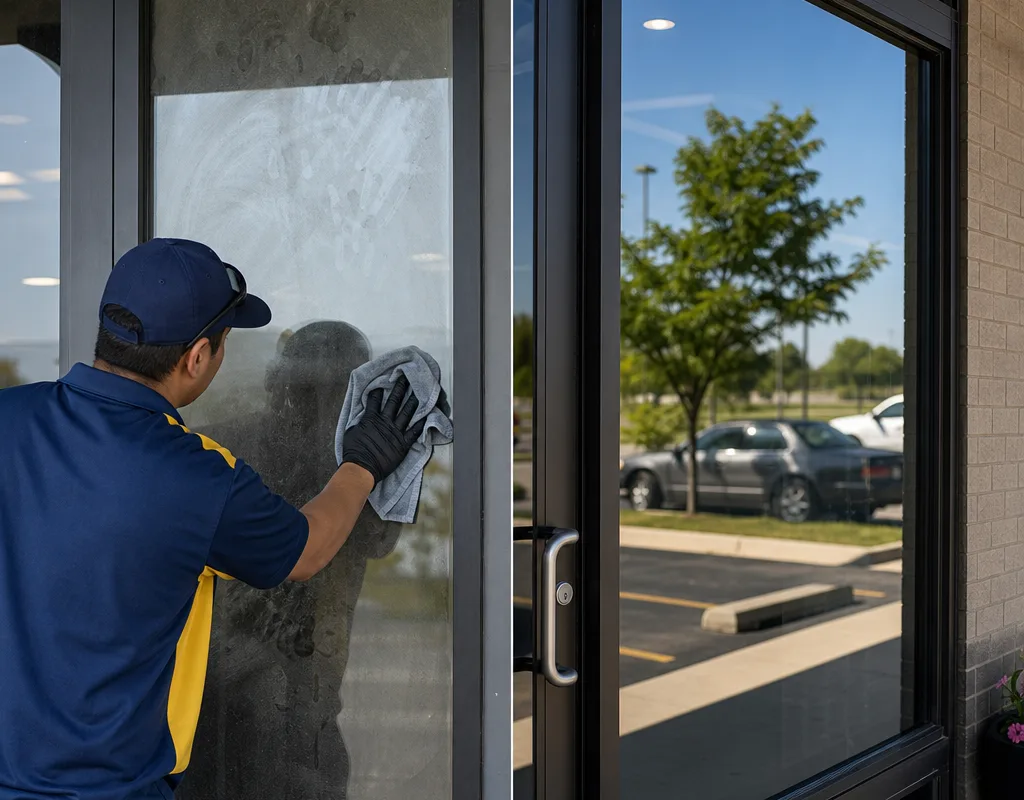
Interior glass walls, sidelights and door glass cleaned edge to edge without streaking. Partition glass is standard in this kind of build and it shows every hand print, especially where light comes across it from the windows.
Counters, the sink and appliance exteriors, the copy and supply area and the staff floor and break seating. Back-of-house gets a solid routine so the labor and the detail work can be concentrated where clients actually spend their time.
A visual standard
In a low-soil building the measure is not whether dirt was removed, because there was not much to begin with. It is whether the room looks composed when somebody walks in. That means finishing work that a task list alone will not produce: edges, corners, the underside of a glass table, the chair that is not quite square to the table.
We match methods to the material and the condition:
A good floor plan is measurable. You can see it in cleaner corners, fewer black heel marks, and entry lanes that do not turn gray halfway through the week. If you are already using walk-off mats, we will treat them as part of the system and build routines around keeping the entry clean, not just the middle of the room.
Entry protocol
Working in a professional or institutional building unsupervised is a trust arrangement, and it should be written down rather than understood. Every detail below goes in the scope before a first visit, whether the building is yours or your landlord's.
Common deep cleaning scopes include:
Deep cleaning is also useful before a VIP visit, after a long stretch of heavy occupancy, or when switching cleaning providers. It creates a clear baseline so everyone can tell what “clean” looks like in your building.
If you manage multi-tenant suites, deep cleaning between occupants can shorten turnover time because the space shows better during walkthroughs, and issues are easier to document and address.
Onboarding a tenant
We walk the suite while it is occupied, because that shows what clients see and where traffic actually goes. An empty office at seven in the evening tells you very little about where attention is needed.
We establish what is yours and what belongs to building management, including corridors, shared restrooms and the floor transition at your entrance, so nothing between the two is left unassigned.
Entry method, alarm sequence, excluded rooms, building rules and escalation contacts are all written down and confirmed with you and, where relevant, with building management before the first visit.
Where you prefer it, a staff member is present for the first clean so your team watches how the route runs and the crew learns the suite before working in it unsupervised.
A supervisor inspects for presentation rather than task completion, looking at the suite the way a visiting client would, and reports what was corrected instead of waiting for you to raise it.

The same people
Professional tenants ask for the same thing more consistently than any other client type: the same people, every time. Familiar faces in a suite after hours are easier to trust, and a crew that knows the space catches things a rotating team never will.
We handle post-construction cleanup for office buildouts and renovations across Des Moines, with scopes that typically include:
If the project is still active, we can coordinate around trades and target specific areas so you can open on schedule. For property managers and contractors, the goal is simple: the space should be clean enough for punch lists, walkthroughs, and move-in without rework.
For facility types that need heavier-duty protocols, the considerations overlap with industrial cleaning in Des Moines, especially around dust control and floor protection during turnover.
Johnston estimates
Professional office cleaning here usually estimates out around $0.12 to $0.35 per square foot per visit. These suites sit toward the upper half of the normal range despite a light soil load, because the work is detail driven: glass, conference rooms and client restrooms take time that does not shrink just because the building is tidy. A typical suite commonly lands near $300 to $1,100 per month at two to five visits a week, with an initial detail clean often estimated at $0.20 to $0.60 per square foot.
The estimate depends on suite square footage, visits per week, restroom count and whether they are client-facing, how much interior glass and partition work there is, conference room count, floor materials, and whether access is escorted. Johnston is in our standard service area and nothing is added for travel. These figures are estimates rather than a quote. Call 515 393 6898 to arrange a walkthrough and a written scope.
Tenant questions
Yes, and for this kind of client it is the arrangement that matters most. Your suite gets a short named crew and a supervisor who has run the route personally. If a substitute is ever needed, you hear about it in advance rather than noticing an unfamiliar person in your space, and the route is documented well enough that the substitute works the same way.
To the building's rules and yours together. Before the first visit we document the entry method, which door the crew uses, the alarm disarm and arm sequence, who is called if a zone faults, and any room excluded from the route. Where building management has its own vendor requirements, we confirm those with them directly rather than assuming your lease covers it.
Nothing at all. Crews clean around them. Documents, files and anything on a desk or in a tray are not moved, stacked, straightened or thrown out, and nothing is read. The only paper removed is what your staff has placed in a trash or shred container. That rule is in the written scope and it applies in private offices and conference rooms equally.
Yes, and most professional suites need that rather than a fixed rotation. A room that sits idle for days and then hosts a client meeting should be reset before the meeting, not three days earlier. We build it as a standing instruction with your office manager: the room is checked and reset when you flag it, on top of its regular place in the route.
Yes, and we would rather you name them up front. Records rooms, server closets, locked file areas and any room with restricted material can be excluded entirely, written into the scope as off the route. If a room needs occasional cleaning under supervision, we schedule it separately with a staff member present instead of giving the crew standing access.
Because what you are buying is presentation rather than soil removal. A low-traffic professional suite still accumulates hand prints on glass, marks on conference tables, dust on sills and traffic soil in carpet, and clients notice all of it while sitting still. Frequency here is set by how often clients are in the space, which is a different question from how dirty it gets.
Arrange a suite walkthrough
Tell us your suite size, your visit frequency and how access works in your building, and we will walk it during business hours and put the route, the access details and the standard in writing. Call 515 393 6898.
Request a quote
Send the details and we will arrange a walkthrough, then follow up with a written scope and a price you can compare line by line.