Cardio and strength equipment
Handles, grips, consoles and buttons, bench pads and upholstery, seat adjustment levers, machine frames and the floor underneath and between units, where dust and rubber particulate collect out of sight of a quick pass.
Serving Des Moines, Iowa & surrounding areas
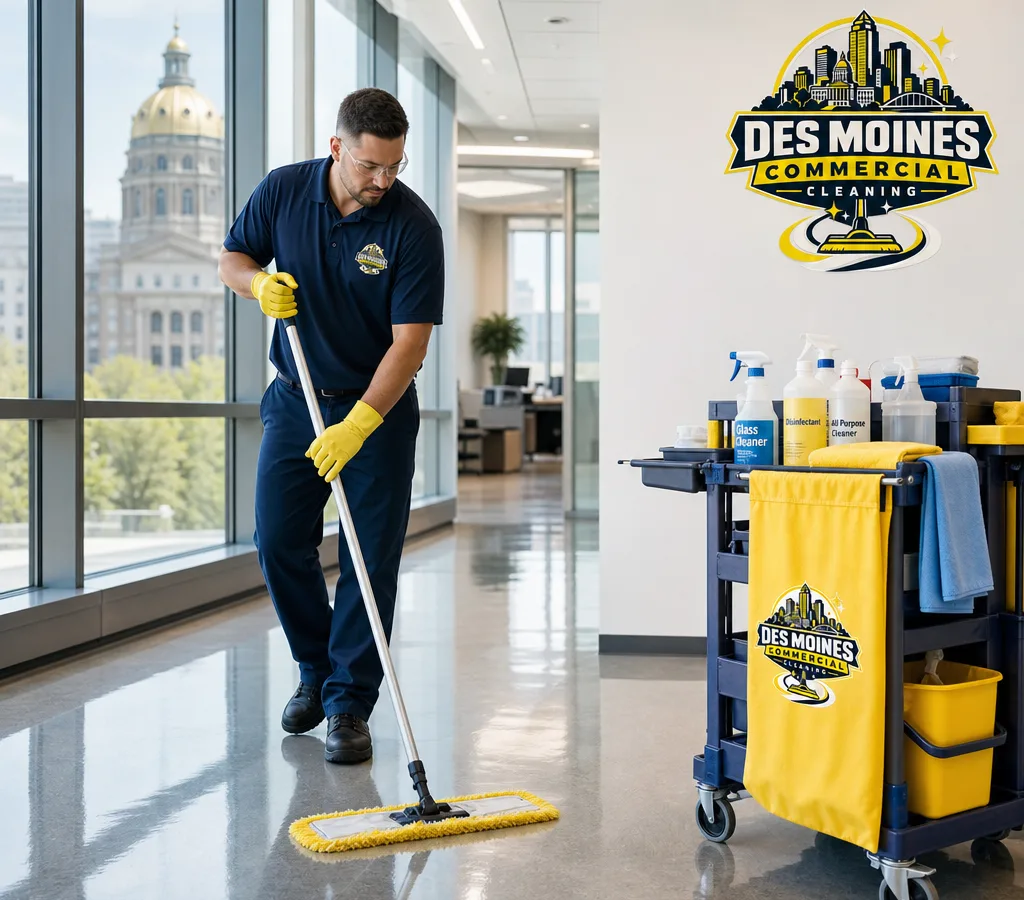
Gym cleaning in Des Moines
Cleaning for Des Moines gyms, fitness centers and studios, where members touch every machine, locker rooms run wet all day, and a 24-hour access door means there is no closed window to work in.
Sweat and moisture
A gym combines two things that are hard to clean on their own: grip surfaces that every member puts their hands on, and rooms that stay wet from open to close. Equipment handles, benches and upholstery collect sweat all day, and a locker room with showers running fourteen hours never fully dries out. Odor in a gym is not an air freshener problem, it is a grout, drain, and upholstery problem.
We clean fitness centers, 24-hour clubs, boutique studios, climbing and martial arts facilities and apartment fitness rooms across the metro. The scope is driven by two facts about your building: there is usually no closed window, and you have three or four different floor types that each require their own method. Plans here are built around a porter rhythm and a strict floor method, not a single nightly route.
If you are comparing providers, start by looking for three things: a written scope that matches your space, a schedule that protects productivity—before hours, after hours, or low-traffic windows—and a plan for floors. Floors show wear fast in Iowa winters and wet spring days, and they are usually the first place a “quick clean” falls short.
For businesses that need help beyond office environments, our team also handles broader commercial cleaning services in Des Moines with the same approach: define the scope, set the routine, then verify the results.
Zones of a club
Handles, grips, consoles and buttons, bench pads and upholstery, seat adjustment levers, machine frames and the floor underneath and between units, where dust and rubber particulate collect out of sight of a quick pass.
Dumbbell handles and racks, barbells and collars, bench and rack uprights, plate trees, and the rubber flooring and platforms where chalk, sweat and dropped-weight residue accumulate faster than anywhere else in the building.
Shower walls and pans, grout and drains, locker exteriors and vents, benches, toilet and sink fixtures, and floors cleaned into the grout line. Soap scum and biofilm are removed rather than covered, which is what actually controls odor.
Wood, sprung or vinyl studio floors cleaned by the manufacturer method, wall mirrors cleaned full height, barres, bike and rower surfaces, and the props, mats and blocks area reset between class blocks.
Full-height mirror walls and interior glass, cleaned edge to edge without streaks or haze. Gym mirrors sit directly in front of members for an entire workout, so they are judged more closely than glass in almost any other building.
Check-in counter and scanner, retail and cooler fronts, lounge seating, water fountains and bottle fillers, entry matting and door hardware, plus trash and towel bins throughout the floor.
Three floor types
Most gyms have at least three flooring materials, and using one method across all of them is the most common damage we see. Rubber tile and roll are porous and react badly to high-pH cleaners. Turf traps particulate and needs agitation rather than flooding. Wood and sprung studio floors need the manufacturer's method and very little water. Each one gets its own equipment and chemistry in the scope.
We match methods to the material and the condition:
A good floor plan is measurable. You can see it in cleaner corners, fewer black heel marks, and entry lanes that do not turn gray halfway through the week. If you are already using walk-off mats, we will treat them as part of the system and build routines around keeping the entry clean, not just the middle of the room.
Odor at the source
Members describe it as a smell, but it is always a surface. Once you treat the surfaces holding moisture and organic soil, the odor stops needing to be masked, which is why fragrance and ozone machines never fix a locker room for more than a day.
Common deep cleaning scopes include:
Deep cleaning is also useful before a VIP visit, after a long stretch of heavy occupancy, or when switching cleaning providers. It creates a clear baseline so everyone can tell what “clean” looks like in your building.
If you manage multi-tenant suites, deep cleaning between occupants can shorten turnover time because the space shows better during walkthroughs, and issues are easier to document and address.
Building the plan
We look at when your building is actually busy: the early morning block, the after-work peak, and whatever quiet hours exist. Cleaning labor gets placed in the troughs, because there is rarely a closed window to use.
Every flooring material is identified and matched to a method and a cleaner, including studio floors where we follow the flooring manufacturer's instructions rather than a general approach.
Daytime porter tasks (touchpoints, locker rooms, mirrors, trash, spot mopping) are separated from overnight or quiet-hour work such as machine floor scrubbing and locker room grout scrubbing.
An opening deep clean on showers, grout, drains and lockers establishes a baseline, since odor in an established club is almost always accumulated rather than recent.
A supervisor walks the club with your general manager at a peak hour, when the building looks its worst, and shifts frequency toward whatever members are most likely to notice.
Around-the-clock access
A club with keyfob access at three in the morning never hands you an empty building, and a studio running classes on the hour gives you ten-minute gaps. Both are workable, but only if the task list is designed around the gaps instead of assuming a quiet night.
We handle post-construction cleanup for office buildouts and renovations across Des Moines, with scopes that typically include:
If the project is still active, we can coordinate around trades and target specific areas so you can open on schedule. For property managers and contractors, the goal is simple: the space should be clean enough for punch lists, walkthroughs, and move-in without rework.
For facility types that need heavier-duty protocols, the considerations overlap with industrial cleaning in Des Moines, especially around dust control and floor protection during turnover.
Club budgets
Gym cleaning in Des Moines usually estimates out around $0.12 to $0.35 per square foot per visit, with locker room square footage effectively costing more than open workout floor because showers, grout and fixtures take far more labor per foot. A studio commonly lands near $400 to $1,200 per month, while a full club with locker rooms and long hours often runs $1,800 to $6,000 or more per month. Locker room deep scrubbing and floor projects are often estimated at $0.25 to $0.70 per square foot.
The estimate depends on open hours, whether you need daytime porter coverage, locker room and shower count, equipment count, how many floor types the building has, class schedule density, and member volume. A 24-hour club with two locker rooms is a different job from a studio open twelve hours. All of this is an estimate only. Call 515 393 6898 for a walkthrough and a written quote.
Club operator answers
In your traffic troughs, with the task list built around them. We map when the building is genuinely quiet, usually mid-morning and the small hours, and place machine floor work and locker room scrubbing there, closing one zone at a time rather than the whole floor. Touchpoints, mirrors and locker rooms get a daytime porter pass, since that is when they get dirty.
By treating surfaces instead of air. Odor comes from biofilm in shower grout and floor drains, moisture in turf and mat backings, sweat in upholstery seams, and damp gear in rental lockers. We scrub grout and drains, clean locker interiors and vents, and clean upholstery regularly. Fragrance and ozone treatments only mask it, and the smell returns within a day.
Yes, and the key is pH. Rubber tile and roll are porous and degrade under high-alkaline cleaners, which is how gym floors end up sticky, faded or crumbling at the seams. We use a neutral pH cleaner with an auto-scrubber, which lifts sweat and particulate out of the texture without attacking the material, and we keep degreasers off it entirely.
Usually both, on different frequencies. Members and your floor staff handle the between-use wipe during the day, which no contractor can be present for. Our crew cleans handles, grips, consoles, bench pads, upholstery seams, frames and the floor under and between machines on a set frequency, which catches the buildup a quick member wipe never reaches.
Yes, following the flooring manufacturer's instructions for the specific floor rather than a general method. Wood and sprung floors need damp cleaning with minimal water, since standing water warps boards and damages a sprung subfloor. We schedule studio cleaning between class blocks so a room is dry and ready at the top of the hour.
Yes, and most clubs should plan for it. January traffic can run well above a normal month, which shows up fastest in locker rooms, equipment touchpoints and the entry. We write the seasonal increase into the scope with a start and end date, usually extra porter hours plus more frequent locker room attention, then step it back down when traffic normalizes.
Set up club service
Tell us your square footage, your open hours and your locker room setup, and we will walk the club at a busy hour and put a porter and deep-clean scope in writing, with the floor methods named. Call 515 393 6898.
Request a quote
Send the details and we will arrange a walkthrough, then follow up with a written scope and a price you can compare line by line.