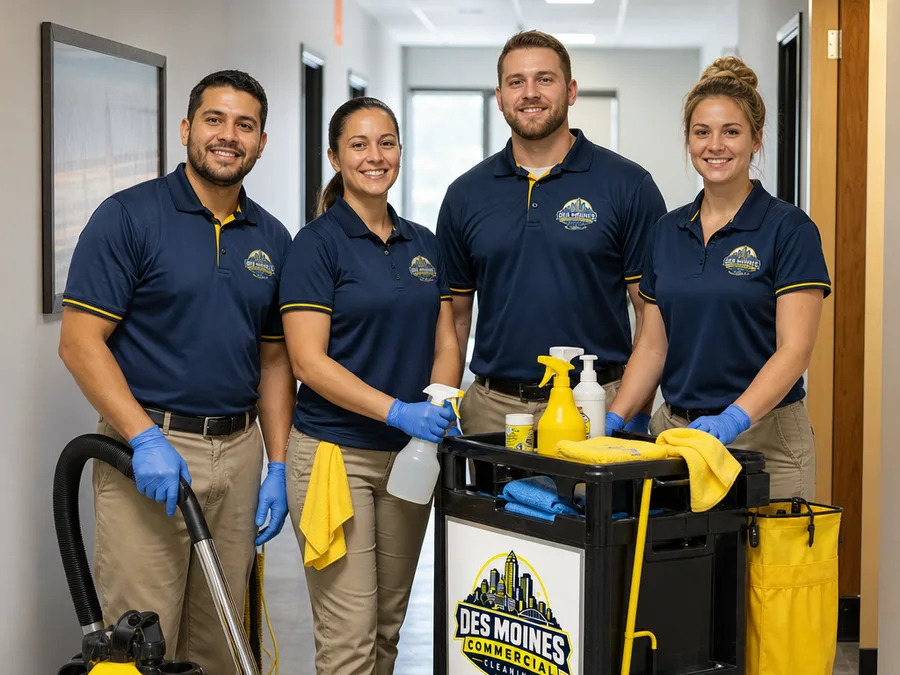
Uniformed Des Moines commercial cleaning crew ready with carts and labeled supplies

Janitorial service in Des Moines

Janitorial Services in Des Moines

Janitorial service is a standing agreement to keep a building clean on a set schedule, written for facility managers who want a named crew, a documented task list, and a contact who answers.

✓Task list in writing
✓Assigned crew leads
✓Scheduled inspections
✓Par levels agreed

The contract itself

What a janitorial contract should actually commit to

Most cleaning complaints are not really about cleaning. They come from a scope nobody wrote down, a crew that changes every month, and no agreed way to report a problem. A janitorial agreement exists to close those three gaps before the first night of service.

Des Moines Commercial Cleaning runs recurring janitorial accounts for offices, clinics, schools, churches, dealerships, and multi-tenant buildings across the metro. The agreement names every task, how often it happens, who performs it, who checks it, and what you do when something is missed. That document is the product, and the cleaning is how it gets delivered.

If you are comparing providers, start by looking for three things: a written scope that matches your space, a schedule that protects productivity—before hours, after hours, or low-traffic windows—and a plan for floors. Floors show wear fast in Iowa winters and wet spring days, and they are usually the first place a “quick clean” falls short.

For businesses that need help beyond office environments, our team also handles broader commercial cleaning services in Des Moines with the same approach: define the scope, set the routine, then verify the results.
Request a Callback

Program components

The parts of a recurring janitorial program

Scope document and frequencies

Every task is listed with a frequency attached: nightly, three nights a week, weekly, monthly, or quarterly. Frequencies are tied to room type rather than to the whole building, so a busy restroom is not treated like a storage closet.

Assigned crew and coverage

You get the same people on your account, with a named lead who knows the building. When someone is out, a trained substitute works from your task list instead of guessing, and the lead records the change in the service log.

Supervisor inspections

A supervisor walks the building on a published rhythm and scores the work against your scope line by line. The report goes to you with what passed, what failed, and the correction date, so the standard is a record instead of an opinion.

Supply levels tracked

We set par levels for soap, towels, tissue, liners, and odor control, track what gets used, and flag a reorder before a dispenser runs empty. Whether we supply the consumables or refill from your stock is agreed in the scope, and priced accordingly.

Day porter hours

For lobbies, fitness areas, and buildings with daytime foot traffic, a porter covers restroom checks, spill response, trash, and entry glass during business hours. Porter hours are quoted separately so you can scale them up through a busy season.

Issue reporting and escalation

Requests go to one contact who logs them, assigns the fix to the crew lead, and records what changed in your scope. Anything that repeats is taken to the next scope review instead of living in a chain of reminder emails.

Request a Callback

Staffing and supervision

Who cleans your building

Turnover is the quiet reason janitorial quality drifts. The answer is structure: training tied to your account, a crew lead who owns the task list, and a supervisor who inspects rather than relying on the crew to grade itself.

We match methods to the material and the condition:

  • Account-specific training before a cleaner works alone in your building, covering surfaces, products, restricted rooms, and alarm handling.
  • A crew lead who signs the nightly service log and reports anything that needs attention from your side of the building.
  • Substitute coverage drawn from people already trained on your scope, not an unfamiliar crew sent in to fill a gap.
  • Keys, fobs, and codes issued to named individuals and recorded, with returns tracked whenever staffing changes.

A good floor plan is measurable. You can see it in cleaner corners, fewer black heel marks, and entry lanes that do not turn gray halfway through the week. If you are already using walk-off mats, we will treat them as part of the system and build routines around keeping the entry clean, not just the middle of the room.

Request a Callback
Clean Des Moines commercial lobby with a professional cleaner and neatly staged supply cart

Where this fits

Facilities that run on a janitorial contract

Recurring janitorial work suits any building where cleanliness is noticed daily and nobody on staff has time to manage it. The scope changes by building type, but the structure stays the same.

Common deep cleaning scopes include:

  • Professional offices and suites in multi-tenant buildings, including shared corridors, elevators, and common restrooms
  • Schools, churches, and community buildings with heavy weekend use and quiet weekday windows
  • Clinics and professional practices where treatment rooms, waiting areas, and restrooms follow your own product list
  • Dealerships and showrooms where glass, service counters, and customer lounges stay visible all day
  • Fitness studios and salons where equipment wipe-downs and restroom checks matter more than square footage

Deep cleaning is also useful before a VIP visit, after a long stretch of heavy occupancy, or when switching cleaning providers. It creates a clear baseline so everyone can tell what “clean” looks like in your building.

If you manage multi-tenant suites, deep cleaning between occupants can shorten turnover time because the space shows better during walkthroughs, and issues are easier to document and address.

Request a Callback

Getting started

From walk to first inspection

01

Building walk

We walk every room with you, count restroom fixtures, note floor types, and ask what went wrong with past cleaners. The complaints tell us more about your building than the square footage does.

02

Draft scope review

You get a draft task list with frequencies attached. Mark anything missing, anything you would rather keep in-house, and anything that has to happen on a specific night, then we revise before pricing is final.

03

Access and schedule

We confirm cleaning windows, alarm codes, door routes, dumpster location, and which rooms stay locked. Buildings with tenants or late staff get a route that starts where the building empties first.

04

Baseline clean

The first visit brings the building to the standard the contract assumes, which usually takes longer than a normal visit. Anything beyond a reasonable baseline is quoted as separate project work before we start.

05

Inspection rhythm

Supervisor inspections begin in the first weeks and settle into a published schedule. The first two reports usually trigger small scope edits, which is normal: the task list should match the building once it has been cleaned a few times.

Request a Callback
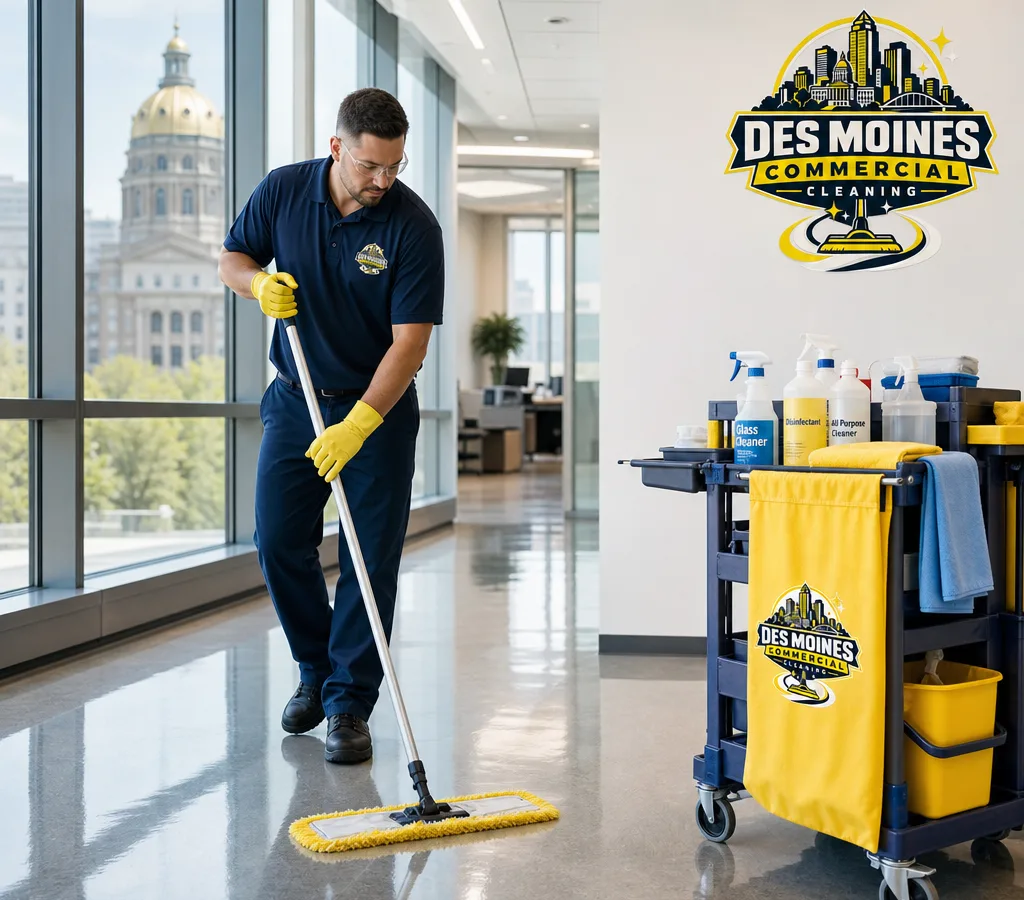
Cleaning technician mopping and detailing a bright modern office corridor with a stocked cleaning cart

Keeping it honest

How quality is measured

A janitorial program stays consistent only if someone checks it on a schedule and writes down the result. We keep that record and share it, including the failures, because a report that always says everything passed is worth nothing to you.

We handle post-construction cleanup for office buildouts and renovations across Des Moines, with scopes that typically include:

  • Line-by-line inspection scoring against your scope, not a general impression of whether the building looks fine
  • Photographs of anything marked failed, attached to the correction note so you can confirm it was handled
  • A nightly service log kept in the building and open to you, recording who worked and what they flagged
  • A quarterly scope review where frequencies move up or down based on what the inspections keep showing
  • An annual pricing and task review so the agreement reflects how the building is actually used now

If the project is still active, we can coordinate around trades and target specific areas so you can open on schedule. For property managers and contractors, the goal is simple: the space should be clean enough for punch lists, walkthroughs, and move-in without rework.

For facility types that need heavier-duty protocols, the considerations overlap with industrial cleaning in Des Moines, especially around dust control and floor protection during turnover.

Request a Callback

Budget planning

How Much Do Janitorial Services Cost in Des Moines?

Recurring janitorial service in Des Moines generally runs about $0.10 to $0.30 per square foot per visit, and many small offices land somewhere around $250 to $900 per month once frequency and restroom count are accounted for. A building that needs five nights a week plus a day porter sits above that, and a 2,000 square foot suite cleaned twice weekly sits below it.

The variables that move the figure most are visits per week, restroom fixture count, whether we supply consumables, floor materials and how much of the building is carpeted, daytime occupancy, and add-ons such as interior glass or periodic floor projects. Treat every number here as an estimate. The figure you can hold us to comes from a walkthrough, a written scope, and a written quote.

Request a Callback

Contract questions

What Des Moines buyers ask before signing a janitorial contract

What is the difference between a janitorial contract and just hiring a cleaner?

A janitorial contract is a standing scope with assigned staff, set frequencies, supervision, and a reporting path. A cleaner hired job by job does whatever gets asked that day. The practical difference shows up in month four: under a contract, the breakroom gets the attention it got in week one, and when it does not, an inspection record says so.

Can we keep buying our own paper goods and chemicals?

Yes. Plenty of facility managers already have purchasing set up and prefer to keep it. We store, rotate, and refill from your stock, then report what gets used each month so your ordering matches reality. If you would rather hand it over, consumables can be folded into the monthly amount with par levels set during the walkthrough.

How do you handle it when the crew misses something?

Report it to your single contact rather than to whoever is on site. It gets logged, assigned to the crew lead with a correction date, and carried onto the next inspection so we can see whether it is a one-off or a scope problem. If the same item appears twice, the frequency or the task wording needs changing, not another reminder.

Do we have to sign a long contract?

Janitorial agreements are written as ongoing service with a defined scope and a notice period, not a lock-in you cannot leave. Most buildings want the stability of the same crew, a known schedule, and pricing that holds. The scope is the part we expect to revisit, and the agreement is built so frequencies can change without a rewrite.

Will the same cleaners come every time?

That is the intent, and it is why each account has a named crew and a lead. Vacations, illness, and staffing changes happen in any cleaning operation. When they do, coverage comes from someone already trained on your task list, and the substitution is written into the service log so you are not finding out from a stranger in your lobby.

What does a day porter do that the nightly crew does not?

A porter works while the building is occupied: restroom checks and restocking through the day, spill and tracked-in water response, entry glass, trash in high-traffic areas, and resetting conference and break spaces. Nightly crews clean an empty building to a standard. A porter keeps a busy building from drifting away from that standard before the next night.

Next step

Get a janitorial scope written for your building

Tell us your square footage, how many nights a week you want service, and the restroom count. We will walk the building and send a task list with frequencies and a price you can compare line by line.

Request a quote

Tell us about your facility

Send the details and we will arrange a walkthrough, then follow up with a written scope and a price you can compare line by line.