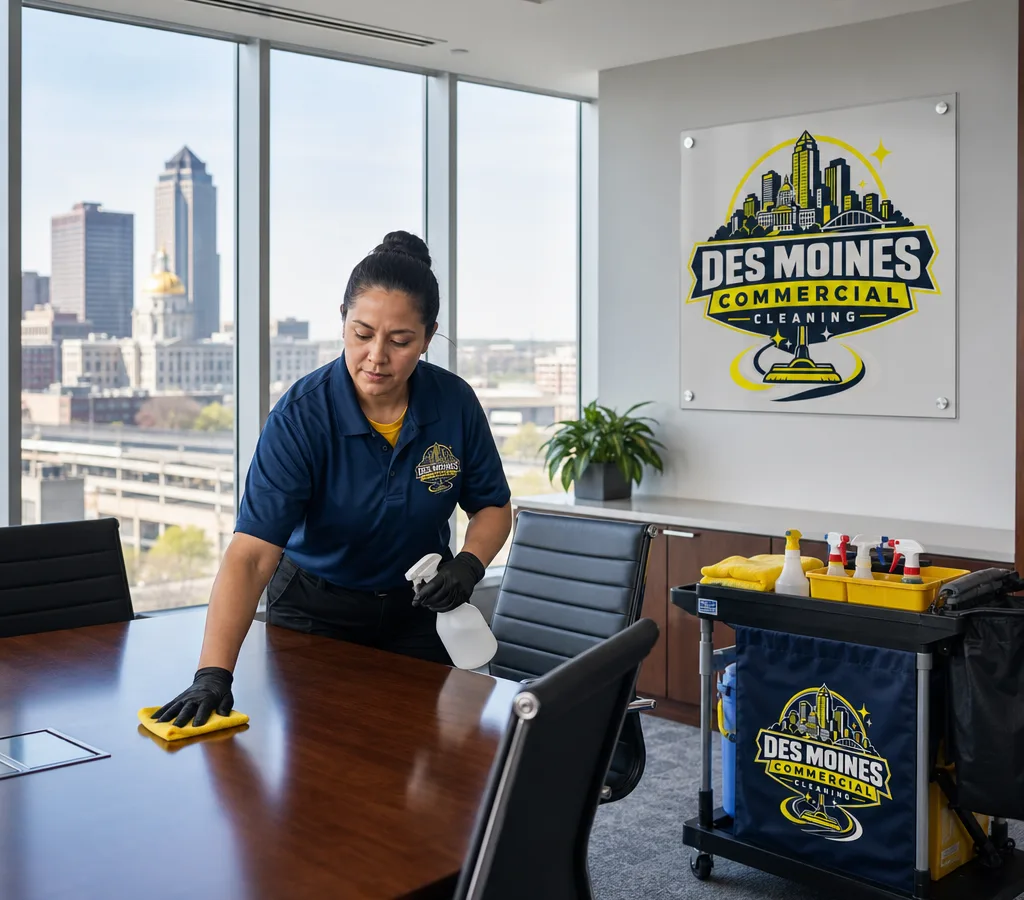
Uniformed cleaner disinfecting a conference table in a modern Des Moines office

Deep cleaning in Des Moines

Commercial Deep Cleaning in Des Moines

A periodic reset for commercial buildings that reaches what nightly cleaning cannot: dust above eye level, scale inside fixtures, grease on vertical surfaces, and the soil that collects behind and under everything.

✓High dusting included
✓Furniture moved and returned
✓Scale and grease removed
✓One-time or scheduled

The buildup problem

Why routine cleaning never catches everything

Routine service is built for speed and repetition: empty, wipe, vacuum, move on. That is the right design, and it leaves a predictable residue behind. Dust climbs onto door frames, vent louvers, light lenses, and the top of partitions. Scale builds inside urinals and under faucet aerators. Grease drifts off microwaves and toasters onto cabinet faces and wall tile.

Deep cleaning is the scheduled correction. We take the building apart in sequence, work high to low with furniture pulled away from the walls, and bring the space back to a standard the regular routine can hold. Floors are part of the plan, though heavy restorative work on carpet and hard surfaces is quoted as floor care rather than folded in here.

If you are comparing providers, start by looking for three things: a written scope that matches your space, a schedule that protects productivity—before hours, after hours, or low-traffic windows—and a plan for floors. Floors show wear fast in Iowa winters and wet spring days, and they are usually the first place a “quick clean” falls short.

For businesses that need help beyond office environments, our team also handles broader commercial cleaning services in Des Moines with the same approach: define the scope, set the routine, then verify the results.
Request a Callback

What gets reached

Where a deep clean actually goes

High dusting above reach

Door frames, partition tops, ceiling vent louvers, light lenses, exit signs, exposed pipe, and the underside of open stairs. These surfaces hold months of dust that falls onto freshly cleaned desks when they are finally touched, which is why they go first.

Restroom descaling

Mineral scale inside urinal traps, under rims, around faucet bases, and on shower and sink fittings is dissolved rather than scrubbed at. Hard water in central Iowa builds it faster than people expect, and it is the usual reason a clean restroom still smells.

Breakroom degreasing

Cabinet faces, backsplashes, appliance sides and tops, microwave interiors, refrigerator door seals, vending surrounds, and the wall behind the coffee station. Grease films hold odor and catch dust, and a daily wipe does not lift them.

Behind and underneath

Desks, file cabinets, lockers, lobby seating, vending machines, and appliances are pulled out so the floor, baseboards, cords, and wall bases behind them get cleaned, then everything goes back on its marks.

Touchpoints and soft surfaces

Switch plates, door hardware, railings, shared equipment, chair arms, fabric panel walls, and upholstered seating, with dwell time observed on any disinfectant you want used. Soft surfaces are tested in a hidden spot before the visible work starts.

Air paths and odor sources

Return air grilles, accessible diffuser faces, fan guards, trash room floors and drains, and the inside of trash containers. Odor almost always has a physical source, and finding it beats covering it with fragrance.

Request a Callback

When buildings book it

Common reasons to reset

A deep clean is usually triggered by an event rather than a date on the calendar. The trigger shapes the scope, so it is worth saying plainly what prompted the call.

We match methods to the material and the condition:

  • A provider change, where a reset creates a shared starting point before a new routine takes over
  • Post-illness resets after a stretch of staff absence, with touchpoints prioritized and dwell times observed
  • A sale, audit, inspection, investor visit, or open house, where the building is being judged on detail
  • Lease turnover, with move-out cleaning to close a space and move-in cleaning before people arrive

A good floor plan is measurable. You can see it in cleaner corners, fewer black heel marks, and entry lanes that do not turn gray halfway through the week. If you are already using walk-off mats, we will treat them as part of the system and build routines around keeping the entry clean, not just the middle of the room.

Request a Callback
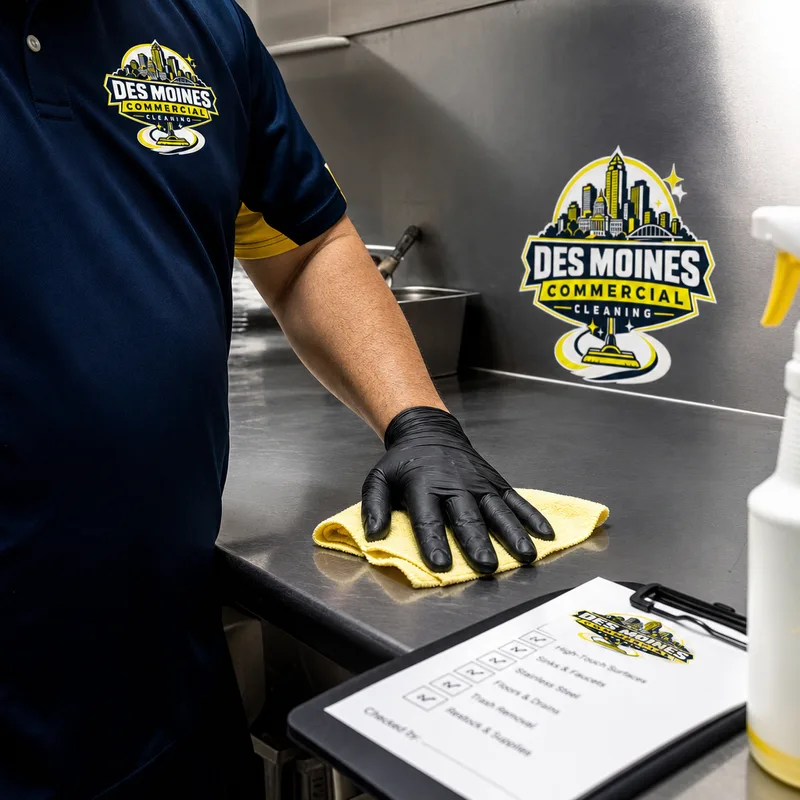
Technician wiping a stainless prep table and backsplash beside a cleaning checklist

Seasonal rhythm

Good times for a reset in Des Moines

Timing a reset to the calendar makes it cheaper and more effective, because you are removing a load the season has just finished depositing.

Common deep cleaning scopes include:

  • Late March or April, once ice melt and winter grit stop arriving at the doors every morning
  • Early summer, when pollen film has settled onto vents, sills, and horizontal surfaces
  • August, before schools, churches, and training facilities fill up again
  • Late fall, ahead of closed windows, holiday gatherings, and the first indoor-air months
  • Any slow week your operation already plans around, which costs less than a night nobody wanted to give up

Deep cleaning is also useful before a VIP visit, after a long stretch of heavy occupancy, or when switching cleaning providers. It creates a clear baseline so everyone can tell what “clean” looks like in your building.

If you manage multi-tenant suites, deep cleaning between occupants can shorten turnover time because the space shows better during walkthroughs, and issues are easier to document and address.

Request a Callback

The sequence

How a reset is run

01

Walk and scope list

We go room by room and write down what has been missed, not what gets cleaned normally. You point at the things that bother you, and we add the surfaces people stop noticing, like vent faces and partition tops.

02

Agree the boundaries

A reset has edges worth setting in writing: what furniture we may move, what stays untouched, whether we handle items left on desks, whether electronics are in scope, and what happens to anything that looks like clutter.

03

Build the night plan

Resets run in sequence, high to low and clean to dirty, zone by zone. We schedule enough hours to finish each zone in one pass, because a half-finished room gets re-dirtied by the work happening above it.

04

Work the plan

A lead works from the written list and marks it off by room, so progress is visible rather than reported. Anything that cannot be completed, like a surface needing a part removed or a repair first, comes back to you as a note.

05

Walk the result

We go through the building with you against the same list, in daylight where it matters. The last step is deciding what the routine schedule should absorb so the same buildup takes longer to return.

Request a Callback
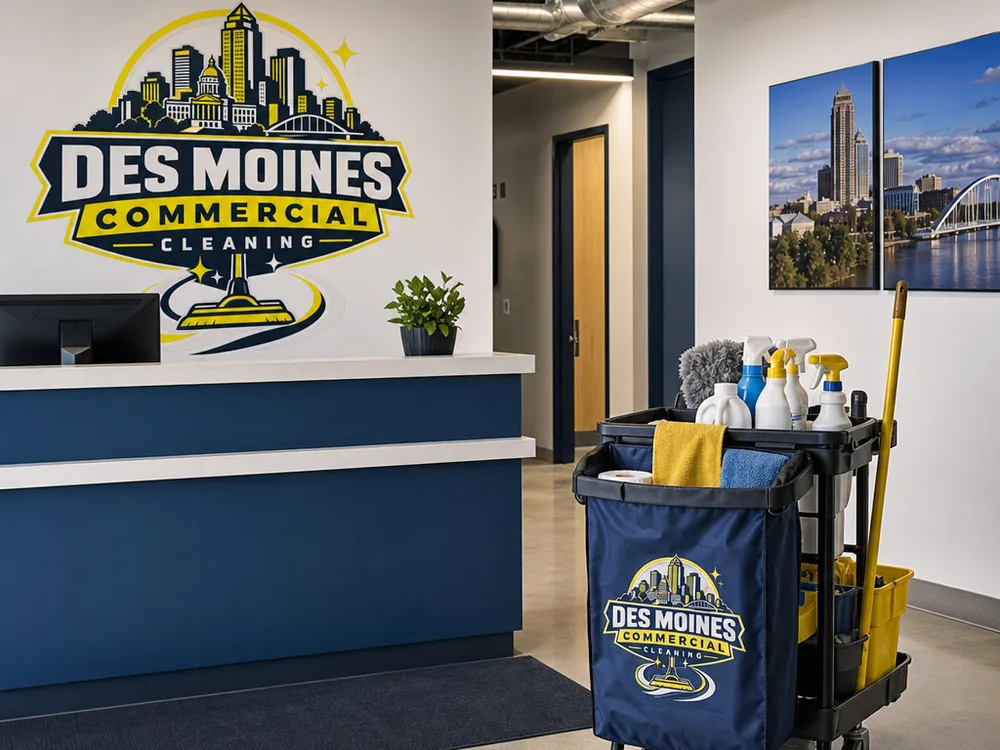
Clean Des Moines commercial lobby with a professional cleaner and neatly staged supply cart

Keeping the result

After the reset

A reset holds for a while and then decays at a rate you can predict. Doing it properly teaches you which items deserve a place in the recurring schedule and which genuinely only need attention once or twice a year.

We handle post-construction cleanup for office buildouts and renovations across Des Moines, with scopes that typically include:

  • Items worth adding to the routine, usually touchpoints, vent faces, and breakroom vertical surfaces
  • Items best left periodic, such as full descaling, high dusting, and pulling heavy furniture away from walls
  • A photo record of the reset standard, so a later complaint can be compared against something concrete
  • A recommended interval for the next reset, based on occupancy and on what we found this time
  • A short list of building issues we noticed, such as failing seals, slow drains, or ventilation dust that keeps returning

If the project is still active, we can coordinate around trades and target specific areas so you can open on schedule. For property managers and contractors, the goal is simple: the space should be clean enough for punch lists, walkthroughs, and move-in without rework.

For facility types that need heavier-duty protocols, the considerations overlap with industrial cleaning in Des Moines, especially around dust control and floor protection during turnover.

Request a Callback

Cost drivers

How Much Does Commercial Deep Cleaning Cost in Des Moines?

Commercial deep cleaning in Des Moines is commonly estimated around $0.20 to $0.60 per square foot, and the spread inside that range is wide because buildup drives it more than area does. A 5,000 square foot space that has been maintained sits near the bottom. The same space after a provider coasted for two years, or after a long stretch of heavy occupancy, sits at the top or beyond it.

Restroom and kitchen count matter more than total square footage, since those rooms carry most of the hours. Furniture volume and whether it can be moved, ceiling height for high dusting, water hardness and scale thickness, how much soft surface is in the space, and whether the work runs overnight or across a weekend all change the figure. Treat these as planning estimates: the real number comes from a walkthrough where the buildup is visible, and it arrives in writing.

Request a Callback

Reset questions

What facility managers ask before booking a deep clean

How is a deep clean different from a thorough regular visit?

A regular visit is scoped to repeat quickly in the same hours every time. A reset is scoped to reach what repetition skips: surfaces above reach, the inside of fixtures, the space behind furniture, and vertical faces. It also takes far longer per square foot and gets planned zone by zone, which is why it is quoted as a project instead of added to a nightly rate.

Do you move furniture, or do we have to clear the space?

We move what two people can handle safely and put it back where it stood: desks, lighter cabinets, lobby seating, vending surrounds. Heavy equipment, server racks, anything bolted down, and anything with cabling nobody wants disturbed stays put unless your team handles it. Clearing items off desk surfaces beforehand makes the result noticeably better.

How long does a deep clean take?

Longer than most buildings expect, and it tracks buildup rather than floor area, since descaling and degreasing are hour-heavy work. Small spaces often fit into one long night, while a building with several restrooms and a full kitchen usually needs a weekend or a few consecutive nights. You get the hour estimate zone by zone before a date is set.

Can you reset the building after a stretch of illness?

Yes, and the scope shifts when that is the reason for the call. Emphasis moves to touchpoints, shared equipment, restrooms, and break areas, with disinfectant left on surfaces for its full dwell time instead of wiped straight off. We make no medical claims about the outcome. What we can give you is a record of exactly which surfaces were treated and with what.

Should we reset before or after new flooring and painting?

After, for anything that creates dust or overspray, otherwise you pay to clean the same room twice. If flooring is being replaced, reset the walls, vents, and fixtures first and let the floor work finish last. Painting and drywall work pushes the job into post-construction territory, which is scoped and sequenced differently again.

How often does a building need this?

Most professional buildings do well on an annual or twice-yearly reset, while heavily used facilities such as schools, gyms, and churches often land on a quarterly rhythm for their worst rooms. The honest answer arrives after the first one: what we find tells us what your building accumulates and how quickly, and the interval follows that evidence.

Book a reset

Schedule a deep clean for your facility

Tell us the square footage, the restroom and kitchen count, and what prompted the call. We will walk the space, list what has been missed, and quote the reset zone by zone.

Request a quote

Tell us about your facility

Send the details and we will arrange a walkthrough, then follow up with a written scope and a price you can compare line by line.