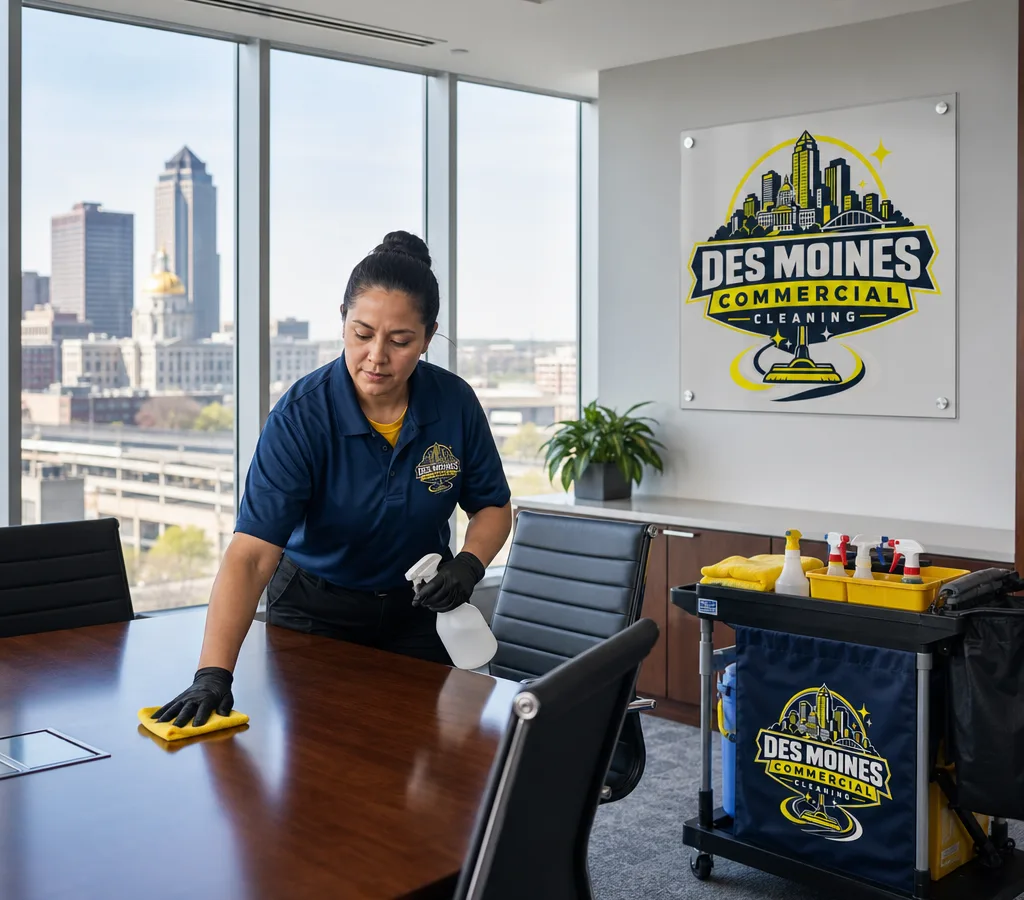
Uniformed cleaner disinfecting a conference table in a modern Des Moines office

Cleaning in West Des Moines

Commercial Cleaning in West Des Moines

Commercial cleaning for offices, suites, retail space and multi-tenant buildings in West Des Moines, built for companies running more than one location that need the same standard at every address.

✓One contract, many sites
✓Same task list
✓Single point of contact
✓Per-site frequency

Several buildings at once

The problem is consistency, not cleaning

This is the broadest commercial mix of any suburb in the metro, which means a lot of companies here are not buying cleaning for one room. They are buying it for a headquarters suite, a second office across town, a retail unit and maybe a warehouse. Each of those gets cleaned well enough on its own. The thing that goes wrong is variance: three locations, three crews, three slightly different interpretations of the same verbal agreement.

We handle that by making the task list the contract and the sites a schedule rather than separate jobs. Every location gets its own site sheet with its materials, access details and frequency, all built from one standard. One contact handles every address, so a frequency change or a complaint is one conversation. Our base is 1800 Dixon St, Suite 4 in Des Moines, which puts the whole metro inside one set of routes rather than requiring a separate arrangement per suburb.

If you are comparing providers, start by looking for three things: a written scope that matches your space, a schedule that protects productivity—before hours, after hours, or low-traffic windows—and a plan for floors. Floors show wear fast in Iowa winters and wet spring days, and they are usually the first place a “quick clean” falls short.

For businesses that need help beyond office environments, our team also handles broader commercial cleaning services in Des Moines with the same approach: define the scope, set the routine, then verify the results.
Request a Callback

Building types served

Spaces we cover across this suburb

Single-tenant offices

A standalone building with its own entrance, parking and restrooms, cleaned end to end: work areas, conference rooms, restrooms, break room, entry and floors. One building, one scope, no coordination with a landlord's vendor required.

Office suites in shared buildings

Your space inside the lease line, cleaned to your scope while the building owner's contractor handles corridors and lobbies. We confirm the boundary in writing first, so no part of the floor plan belongs to nobody.

Multi-tenant common areas

For owners and property managers: corridors, shared restrooms, elevator lobbies in low-rise buildings, stairwells, vestibules and the shared janitorial closet. These are scoped separately from tenant space and usually run on a different frequency than the suites do.

Retail and service storefronts

Sales floor, customer restroom, fitting or consultation areas, entry glass and the matting system, plus back-of-house and the trash staging area. Storefront work is scheduled around your open hours rather than against them, so the floor is reset before customers arrive.

Conference and training rooms

Rooms that sit empty for days and then host thirty people: tables, chair arms and bases, glass partitions, floors and the trash and recycling. Reset after use rather than only on the fixed rotation.

Warehouse and storage space

Office and restroom areas inside a warehouse building, plus the concrete in walk lanes, staging areas and around the dock door. Scoped as its own site sheet because it has little in common with the office next to it.

Request a Callback

One standard everywhere

One standard, several sites

Multi-site cleaning holds together on documentation rather than goodwill. Every location is written as a site sheet, built from one task list, so the standard is the same everywhere while the details stay local to each building. That is what lets a supervisor walk into any one of your addresses and know what should have been done the night before.

We match methods to the material and the condition:

  • One master task list, with a per-site sheet naming that building's materials, access, restroom count and frequency.
  • Supervisor visits rotated across your locations, so no site goes months without someone checking it against the scope.
  • A single contact for every address, so a change or a complaint is handled once instead of site by site.
  • Issues logged with the location, the date and the correction, which gives you a record across the whole portfolio.

A good floor plan is measurable. You can see it in cleaner corners, fewer black heel marks, and entry lanes that do not turn gray halfway through the week. If you are already using walk-off mats, we will treat them as part of the system and build routines around keeping the entry clean, not just the middle of the room.

Request a Callback
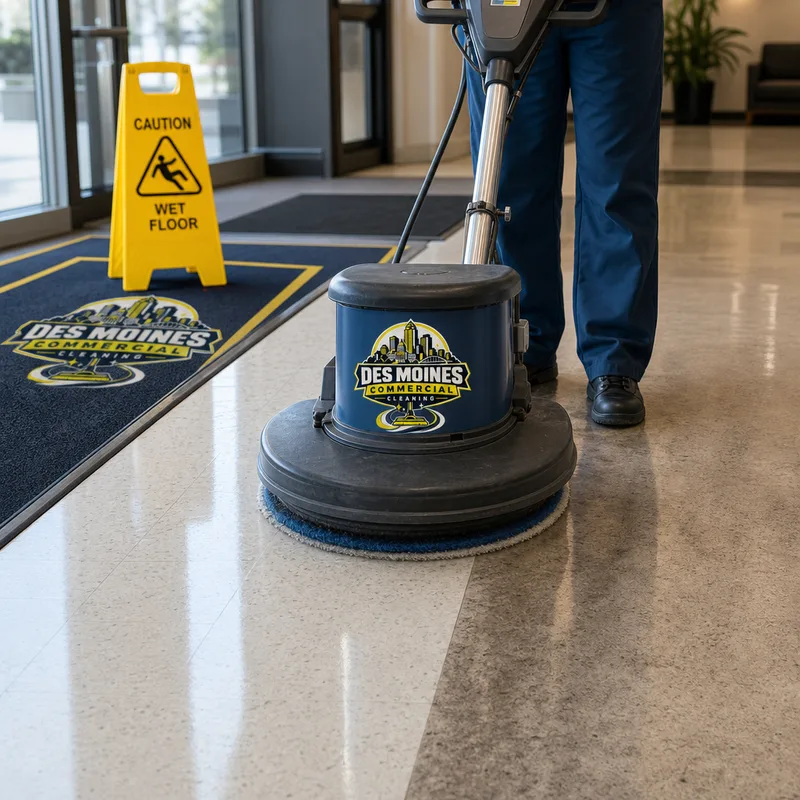
Technician using an auto-scrubber on VCT flooring in an office lobby beside entry matting and a wet floor sign

Suites and common areas

Who cleans what in a leased building

In a multi-tenant building, the gaps are at the boundaries. Most disputes we see are not about quality: they are about a stretch of floor, a shared restroom or a closet that each party assumed belonged to the other.

Common deep cleaning scopes include:

  • Tenant space inside the lease line is normally the tenant's responsibility, and we scope it that way unless your lease says otherwise.
  • Corridors, shared restrooms, stairwells and vestibules are usually the building owner's, under a separate agreement.
  • The floor transition at your suite entrance gets named explicitly, because it is the single most commonly skipped area.
  • A shared janitorial closet needs an agreement on storage and sink use when more than one contractor works in the building.
  • Trash routing to a shared dumpster or compactor follows building rules, which we confirm before the first visit rather than after.

Deep cleaning is also useful before a VIP visit, after a long stretch of heavy occupancy, or when switching cleaning providers. It creates a clear baseline so everyone can tell what “clean” looks like in your building.

If you manage multi-tenant suites, deep cleaning between occupants can shorten turnover time because the space shows better during walkthroughs, and issues are easier to document and address.

Request a Callback

Adding locations

How sites get added

01

Walk every address

Each location gets its own walkthrough, because square footage tells you very little. A compact suite with three restrooms takes more labor than a larger open floor with one, and only a walk shows that.

02

Build one task list

We write a single standard covering what gets done at every site, then attach a site sheet per building for materials, access, restroom count, frequency and anything specific to that address.

03

Sort out access per site

Keys, codes, fobs, alarm sequences and any landlord rule are documented per location, since the arrangement is rarely the same in a standalone building and a managed one.

04

Stagger the starts

Locations usually begin a week or two apart rather than all at once. That gives each site a proper baseline clean and lets us correct an issue at one address before it repeats across the rest.

05

Review the portfolio

We review all sites together at set intervals, comparing what each is getting against what it needs, and move frequency between locations when one has grown and another has not.

Request a Callback
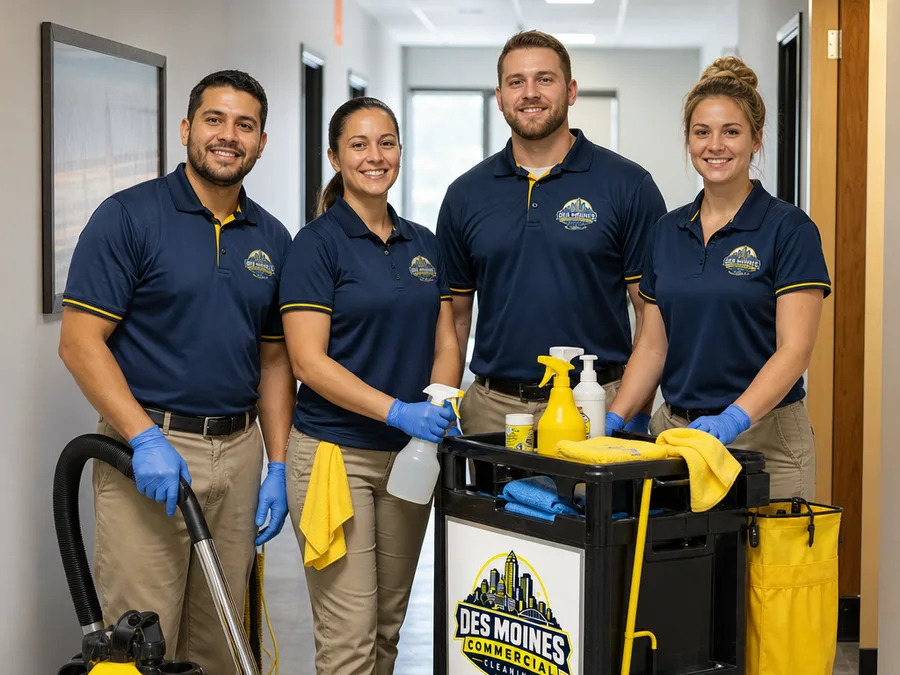
Uniformed Des Moines commercial cleaning crew ready with carts and labeled supplies

Reporting across sites

Knowing what happened where

Running several buildings means you cannot personally inspect any of them often. What replaces that is a record: which site was visited, what was flagged, what was corrected and when. Without it, you only hear about cleaning when somebody is annoyed.

We handle post-construction cleanup for office buildouts and renovations across Des Moines, with scopes that typically include:

  • Each site inspected against its own sheet, with the result recorded rather than passed along verbally.
  • Issues raised to you with the location and date attached, including what we corrected without being asked.
  • Your own staff able to report a problem through one contact, no matter which building they are in.
  • Frequency and scope changes confirmed in writing per site, so no address drifts from what you agreed.
  • One schedule and one invoicing arrangement across every location, with per-site detail available when you want it.

If the project is still active, we can coordinate around trades and target specific areas so you can open on schedule. For property managers and contractors, the goal is simple: the space should be clean enough for punch lists, walkthroughs, and move-in without rework.

For facility types that need heavier-duty protocols, the considerations overlap with industrial cleaning in Des Moines, especially around dust control and floor protection during turnover.

Request a Callback

Multi-site estimates

How Much Does Commercial Cleaning Cost in West Des Moines?

Routine commercial cleaning here typically estimates out around $0.10 to $0.30 per square foot per visit, with smaller offices and suites often landing near $250 to $900 per month depending on frequency and restroom count. Larger single sites and multi-location programs are usually built as a monthly figure across all addresses. Initial resets and periodic deep cleans are generally estimated at $0.20 to $0.60 per square foot.

Across several buildings the estimate depends on the number of locations, square footage and restroom count at each, visits per week per site, floor materials, how much common area is included, and whether any location needs daytime coverage. Every one of these suburbs is in our standard service area, so a multi-site quote carries no travel surcharge for spreading across the metro. All of this is an estimate. Call 515 393 6898 to get each address walked and a written quote.

Request a Callback

Multi-location answers

Questions from companies running several locations

We have four locations around the metro. Can one contract cover all of them?

Yes, and that is usually the better arrangement. One contract, one task list and one schedule, with a site sheet per address carrying its materials, access details, restroom count and frequency. You get one contact for all four, so a change or an issue is handled once. Each building still gets walked and priced individually, because square footage alone does not predict the labor.

How do you keep two buildings cleaned to the same standard?

By making the standard a document instead of an expectation. Both sites work from one master task list, each has its own sheet for local detail, and a supervisor rotates between them inspecting against that paperwork. When a standard lives only in a conversation, two crews will interpret it two ways within a month, however good both of them are.

We lease a suite in a managed building. Who handles the corridors?

Almost always the building owner, through their own contractor, while your scope covers your space inside the lease line. We confirm that split in writing before the first visit and name the floor transition at your suite entrance specifically, since that strip is the most commonly skipped area in any leased building.

Can each of our locations run on a different frequency?

Yes, and most portfolios should. A busy customer-facing site might need five visits a week while a quiet second office needs two. Frequency is set per site from how that building is actually used, not spread evenly for tidiness. We review it across all your addresses at intervals and shift it when one location grows.

Do we get one invoice or one for each site?

Either, whichever suits your accounting. Most clients take one monthly arrangement across all locations with per-site detail available, since it is simpler to approve. If your sites are separate cost centers, we can split it by address instead. The scope and the price are documented per location regardless of how the billing is grouped.

What happens if a crew is short-staffed at one of our buildings?

The route gets covered by trained backup rather than skipped, and if coverage is reduced on a given night you hear it from us instead of discovering it. Running several locations on one contract is what makes that possible: there is depth in the schedule across the metro rather than one person assigned to one address.

Consolidate your vendors

Put every location on one cleaning contract

Send us the addresses, approximate square footage and the frequency you want at each, and we will walk them, build one task list with a sheet per site, and quote it in writing. Call 515 393 6898.

Request a quote

Tell us about your facility

Send the details and we will arrange a walkthrough, then follow up with a written scope and a price you can compare line by line.