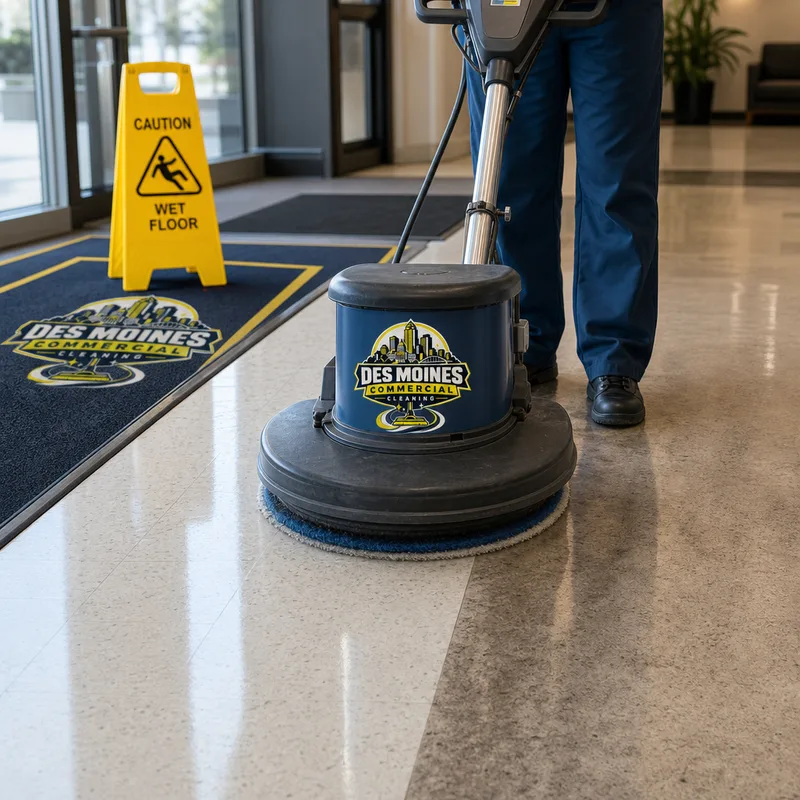
Technician using an auto-scrubber on VCT flooring in an office lobby beside entry matting and a wet floor sign

Floor care in Des Moines

Commercial Floor Care in Des Moines

Periodic floor work for commercial buildings: carpet extraction, finish restoration on VCT, careful cleaning for LVT, polished and sealed concrete, and tile grout, matched to the material instead of sold as one package.

✓Material-matched methods
✓Condition checked first
✓Dry times planned
✓Slip resistance considered

Surface by surface

Floor care is a material question, not a package

Floors are the most expensive surface in most commercial buildings and the easiest to ruin with the wrong product. A high-speed pad that makes VCT shine will haze LVT. A stripper that lifts old finish cleanly can bleach grout. An extractor run with too much solution can wick stains back up through carpet backing overnight.

Des Moines Commercial Cleaning treats floor care as scheduled project work: identify the material and its condition, pick a method the manufacturer allows, then set a cycle that keeps the floor ahead of wear. It sits alongside nightly cleaning, which handles dust mopping and vacuuming, and it is where the real condition of a floor gets decided.

If you are comparing providers, start by looking for three things: a written scope that matches your space, a schedule that protects productivity—before hours, after hours, or low-traffic windows—and a plan for floors. Floors show wear fast in Iowa winters and wet spring days, and they are usually the first place a “quick clean” falls short.

For businesses that need help beyond office environments, our team also handles broader commercial cleaning services in Des Moines with the same approach: define the scope, set the routine, then verify the results.
Request a Callback

Services by material

Floor types we maintain and restore

Carpet and carpet tile

Hot water extraction pulls soil that vacuuming leaves in the pile, with pre-spray dwell time, agitation on traffic lanes, and spot treatment chosen by stain type. Encapsulation is used where a fast dry time matters more than depth of clean.

VCT strip and recoat

Scrub and recoat restores the top layers of finish on a cycle, while a full strip takes everything back to bare tile and rebuilds four or five coats. Which one you need depends on how many coats remain and whether dirt sits in the finish or under it.

LVT and resilient plank

Luxury vinyl plank and sheet goods want neutral cleaners, low-speed machines, and soft pads. Most damage we get called to fix came from finish applied where the manufacturer did not want it, or from high-speed burnishing that clouded the wear layer.

Polished and sealed concrete

Mechanically polished concrete is maintained with densifier-compatible cleaners and diamond-impregnated pads, never floor finish. Sealed slabs get auto-scrubbing plus a periodic reseal once the coating thins out at entries and traffic lanes.

Tile and grout

Grout lines sit below the tile surface, which is why mopping darkens them over time: dirty water collects in the joints and dries there. We clean with pressure and recovery, then discuss sealing to slow the next cycle in restrooms and entries.

Entry matting systems

Most soil in a building walks in through the first twenty feet. We look at mat length, type, and placement, clean or rotate mats on a frequency, and treat the entry as a control point rather than a mess to mop up later.

Request a Callback

Finish and gloss

Keeping a finish alive

Floor finish is a wear layer you are meant to spend. Burnishing and recoating put back what traffic takes off. Stripping is what you resort to when that cycle has been skipped for years and soil is locked under the coats.

We match methods to the material and the condition:

  • Burnishing on a set cycle to restore gloss and harden the finish surface before grit grinds into it
  • Scrub and recoat to add coats back, scheduled by traffic volume rather than by a date on the calendar
  • Full strip and refinish only when coats are contaminated or have built up unevenly against walls and corners
  • Finish selection matched to your traffic and maintenance budget, since high-gloss systems demand more frequent attention

A good floor plan is measurable. You can see it in cleaner corners, fewer black heel marks, and entry lanes that do not turn gray halfway through the week. If you are already using walk-off mats, we will treat them as part of the system and build routines around keeping the entry clean, not just the middle of the room.

Request a Callback
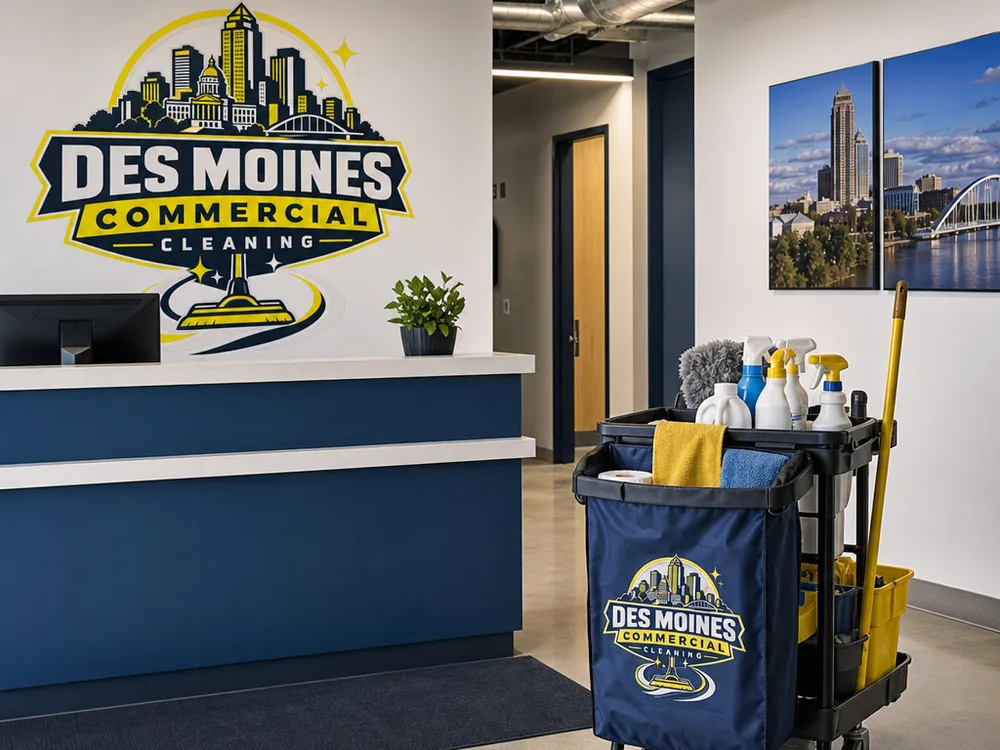
Clean Des Moines commercial lobby with a professional cleaner and neatly staged supply cart

Local wear patterns

What wears commercial floors in central Iowa

Floors in Des Moines buildings take seasonal abuse that shows up in predictable places, which is why scheduling matters as much as method.

Common deep cleaning scopes include:

  • Ice melt and road salt tracked in from December through March, leaving white film and abrasive grit at entries
  • Spring rain and lawn treatment residue carried onto carpet lanes from parking lots and sidewalks
  • Summer dust and pollen film on hard floors, most visible on dark VCT and on polished concrete
  • Pallet jack and cart wheels cutting black marks into finish along the same interior routes every day
  • Chair casters and foot scuff in conference and training rooms, concentrated in a few square feet under tables

Deep cleaning is also useful before a VIP visit, after a long stretch of heavy occupancy, or when switching cleaning providers. It creates a clear baseline so everyone can tell what “clean” looks like in your building.

If you manage multi-tenant suites, deep cleaning between occupants can shorten turnover time because the space shows better during walkthroughs, and issues are easier to document and address.

Request a Callback

How a project runs

Floor project, start to finish

01

Identify the material

We confirm what is actually down, which is not always what the building thinks: VCT and LVT look alike under old finish, and polished concrete gets mistaken for a sealed slab. That answer decides every product used afterward.

02

Condition assessment

We check coat count, soil depth, gloss, grout color against a hidden sample, and whether damage is wear or chemical. A test patch in a low-visibility corner settles arguments about how far the floor can come back.

03

Schedule and dry time

Work is planned around occupancy and cure times: recoating needs hours of untouched floor, extraction needs air movement, and a strip job on a Friday night gives new finish the weekend to harden before carts roll.

04

Protect and prepare

Furniture is moved or worked around by agreement, baseboards and transitions are protected, and signage routes people away from wet floors. Cords, water supply, and waste water disposal are sorted before machines come out.

05

Inspect and set the cycle

We walk the finished floor with you under the lighting you actually use, then write the next cycle into the schedule: burnish monthly, extract quarterly, recoat annually, or whatever traffic and budget support.

Request a Callback
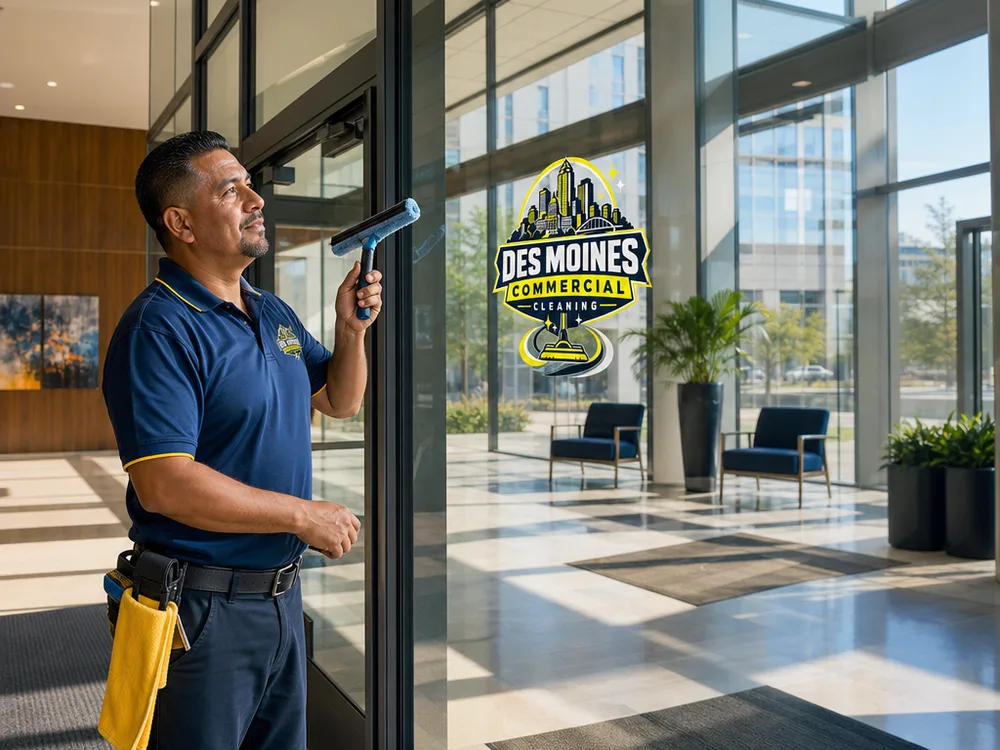
Clean office building lobby glass wall and entry doors with clear, streak-free visibility

Safety and documentation

Slips, signage, and records

Wet work and slip risk belong in the same conversation. A floor that looks excellent and turns slick when damp is a liability rather than a result, so product and method choices are written down with the rest of the job.

We handle post-construction cleanup for office buildouts and renovations across Des Moines, with scopes that typically include:

  • Finish and cleaner selections kept on file with product data sheets for each floor in the building
  • Signage and barrier plans agreed in advance for occupied buildings, including after-hours entry by staff or tenants
  • Attention to slip resistance when choosing finishes and pads, particularly at entries and on ramps
  • Before and after photographs of each project area, dated, so the cycle can be judged on evidence
  • A written cycle schedule, so the next recoat is booked rather than remembered once the gloss is gone

If the project is still active, we can coordinate around trades and target specific areas so you can open on schedule. For property managers and contractors, the goal is simple: the space should be clean enough for punch lists, walkthroughs, and move-in without rework.

For facility types that need heavier-duty protocols, the considerations overlap with industrial cleaning in Des Moines, especially around dust control and floor protection during turnover.

Request a Callback

Project estimates

How Much Does Commercial Floor Care Cost in Des Moines?

Floor care is priced by the job and by the material. For planning: machine scrubbing and deep cleaning of hard floors generally estimates around $0.20 to $0.60 per square foot, strip and refinish runs higher at roughly $0.50 to $1.25 per square foot because of the labor and the coat count, carpet hot water extraction commonly falls near $0.20 to $0.40 per square foot, and burnishing or polished-concrete maintenance tends to land around $0.10 to $0.30 per square foot per pass.

Condition is the biggest variable and the one nobody can price over the phone: a floor kept on a cycle costs a fraction of a floor that has been mopped for six years and needs stripping first. Furniture moving, weekend or overnight scheduling, obstructed layouts, grout condition, and the number of coats specified all shift the estimate. These are planning ranges only, and a written quote follows a site visit and a test patch.

Request a Callback

Floor questions answered

Common questions about carpet, tile, and concrete floors

How often should we extract commercial carpet?

Traffic decides it. A quiet professional suite may hold up with extraction twice a year, an entry-heavy lobby or a school corridor often needs quarterly, and food-adjacent areas more again. The useful signal is lane color: once the main walking path reads a shade darker than the carpet beside it, you are already overdue and spot cleaning will not close the gap.

Is stripping and waxing bad for our floors?

Not bad, but overused. Each strip removes finish and a little of the tile surface with it, so a building stripping annually out of habit is spending money and tile life it does not need to. Keep up with scrubbing, recoating, and burnishing and most VCT needs a full strip only every few years, usually when coats have built unevenly at the edges.

Can you put a shine on our LVT like the old tile had?

Generally no, and you would not want it. Luxury vinyl ships with its own finished wear layer, and most manufacturers advise against floor finish on top: coatings peel at the seams and trap dirt in the gaps. What we can do is clean it properly with neutral products and low-speed equipment, which brings back the sheen the material was made with.

What happens to grout after years of mopping?

Mop water carries soil into the joints, where it dries below the tile surface, so grout darkens a shade at a time until people assume that is the color. Pressure cleaning with recovery usually brings most of it back, and the honest answer about how much comes from cleaning a hidden test square first. Sealing afterward slows the next round.

Do you work after hours and on weekends?

Most floor projects require it. Recoating and refinishing need a floor nobody walks on while coats dry, and extraction needs air movement and time. We plan projects into evenings, weekends, or shutdown days, and we tell you up front how many hours the area has to stay closed so nobody opens a door onto wet finish.

How do we stop salt and grit wrecking the entry every winter?

Matting and frequency, mostly: enough walk-off matting to catch several footfalls, mats cleaned or swapped often enough to stay absorbent, and a winter schedule that raises entry attention instead of holding the summer routine. Neutralizing ice melt residue matters too, because left alone it leaves a white film that dulls finish and grinds into the surface.

Request a quote

Get a floor care cycle built for your building

Tell us what is on the floor, how old the finish is, and when the space can close. We will assess condition, run a test patch, and quote the project with a maintenance cycle attached.

Request a quote

Tell us about your facility

Send the details and we will arrange a walkthrough, then follow up with a written scope and a price you can compare line by line.