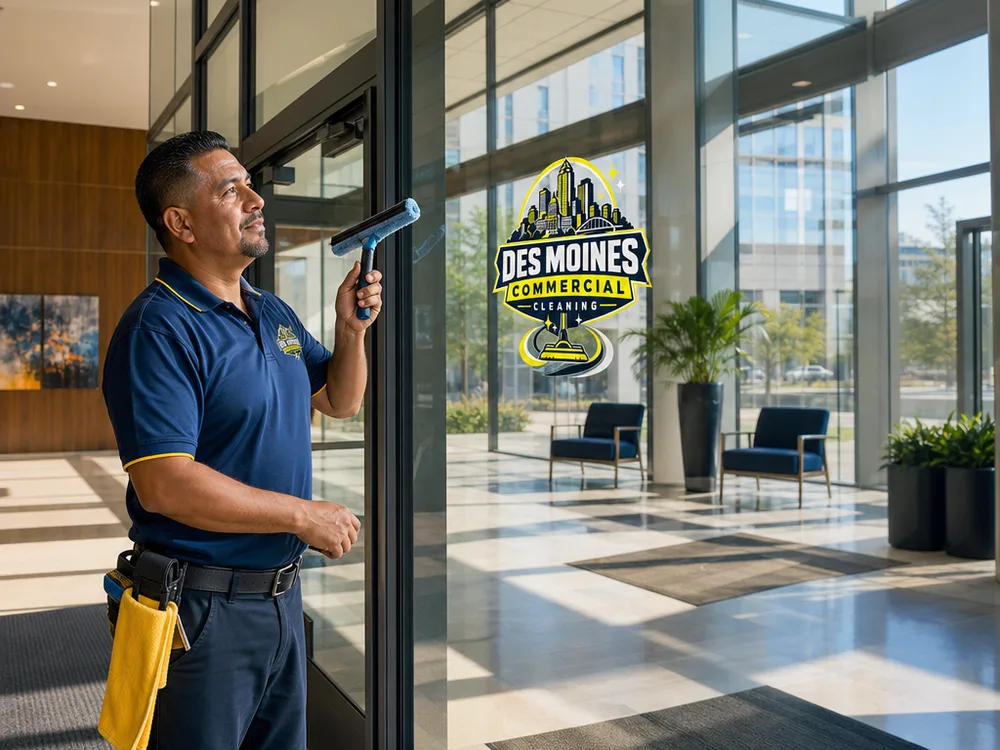
Clean office building lobby glass wall and entry doors with clear, streak-free visibility

Retail cleaning in Des Moines

Retail Cleaning in Des Moines

Cleaning for Des Moines storefronts, big-box tenants and shopping centers, where the sales floor is under customer eyes every open hour and winter slush walks in at the door with each visitor.

✓Dry entries in winter
✓Fitting rooms reset
✓Glass without prints
✓Overnight or pre-open

Open while cleaning

Your sales floor is on display all day

A store is judged while it is being used. Nobody sees your cleaning crew, but every customer sees the smudge on the display case, the footprint trail from the door, and the fitting room with a hanger on the floor. Retail cleaning is mostly about presentation holding up from open to close, not about how good the floor looked at four in the morning.

We clean single storefronts, strip center tenants, big-box space and multi-tenant shopping centers across the metro. The plan splits in two: what happens overnight or before open to reset the floor, and what happens during the day so it has not drifted by three on a Saturday. Back of house gets its own list, because a stockroom nobody cleans eventually turns up on the sales floor as dust and dirty cartons.

If you are comparing providers, start by looking for three things: a written scope that matches your space, a schedule that protects productivity—before hours, after hours, or low-traffic windows—and a plan for floors. Floors show wear fast in Iowa winters and wet spring days, and they are usually the first place a “quick clean” falls short.

For businesses that need help beyond office environments, our team also handles broader commercial cleaning services in Des Moines with the same approach: define the scope, set the routine, then verify the results.
Request a Callback

Front and back

What we cover from the entry to the stockroom

Sales floor and aisles

Floors swept and machine cleaned on a cadence that matches traffic, fixture bases and lower shelves dusted, endcap and display surfaces wiped, and the aisle ends where carts and strollers scuff the finish on their way around a corner.

Entries and vestibules

Mats lifted and the floor cleaned underneath, tracked soil removed from the first fifteen feet, door glass and push plates cleared of hand prints, and threshold tracks cleaned out where grit and meltwater collect all winter.

Fitting rooms

Mirrors, benches, hooks and the corners where tags, pins and lint gather. Fitting room floors get detailed rather than passed over, because a customer standing still in a small room has plenty of time to look down.

Glass, cases and mirrors

Display case tops and fronts, interior partition glass and full-height mirrors, cleaned with the lighting in mind: overhead retail lighting picks out every streak and swirl that a fast pass leaves behind on glass.

Stockroom and back of house

Receiving area floors, break room, trash and recycling staging, and the aisles between stock shelving. A clean stockroom keeps dust and cardboard fiber from migrating out onto merchandise and fixtures on the sales floor.

Customer restrooms

Fixtures, dispensers, partitions, mirrors and floors cleaned into the grout, on a frequency matched to customer count rather than square footage, with a daytime check added on busy weekends and holiday dates.

Request a Callback

Entry matting

Stopping salt at the door

Most of the soil in a Des Moines store arrives on shoes between November and April, and it is not plain dirt. It is de-icing salt and sand carried in meltwater, which dries to a white film on hard floors and grinds carpet fiber flat. The fix is physical rather than chemical: enough matting to take several footfalls, lifted and cleaned often, plus a cleaner that removes salt residue instead of smearing it around.

We match methods to the material and the condition:

  • Matting sized to catch three or four footsteps inside the door, not a single mat sitting at the threshold.
  • Mats lifted every visit so the floor underneath is cleaned instead of being sealed under a wet rubber backing.
  • Neutral or salt-neutralizing cleaner on hard floors in winter, since high-alkaline products leave a haze of their own.
  • Extra entry passes scheduled during a thaw, when meltwater tracks in more residue than a fresh snowfall does.

A good floor plan is measurable. You can see it in cleaner corners, fewer black heel marks, and entry lanes that do not turn gray halfway through the week. If you are already using walk-off mats, we will treat them as part of the system and build routines around keeping the entry clean, not just the middle of the room.

Request a Callback
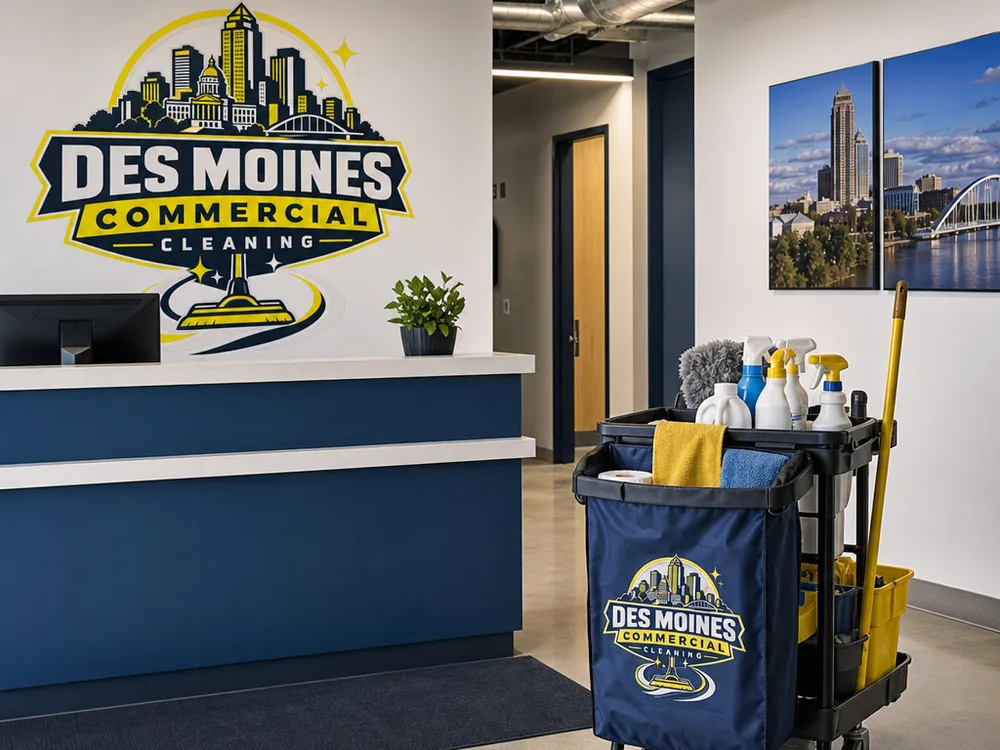
Clean Des Moines commercial lobby with a professional cleaner and neatly staged supply cart

Center common areas

Common areas in a multi-tenant shopping center

In a center, tenant complaints start in the common area. It belongs to nobody, so it drifts first, and every tenant's customer walks through it. Common-area work is scoped separately from tenant space and usually needs daytime coverage as well as an overnight reset.

Common deep cleaning scopes include:

  • Corridors, seating areas and the floor transitions where each tenant entry meets common tile.
  • Food court tables, chair bases, trash and tray stations, and the floor under seating where spills dry in place.
  • Entrance vestibules at every building door, including glass, matting and winter grit.
  • Common restrooms on a daytime check schedule rather than a nightly clean alone.
  • An exterior entry sweep: cigarette butts, cart corrals and the apron where parking lot soil begins.

Deep cleaning is also useful before a VIP visit, after a long stretch of heavy occupancy, or when switching cleaning providers. It creates a clear baseline so everyone can tell what “clean” looks like in your building.

If you manage multi-tenant suites, deep cleaning between occupants can shorten turnover time because the space shows better during walkthroughs, and issues are easier to document and address.

Request a Callback

Setting up service

How store service starts

01

Walk the floor at peak

We prefer a walkthrough while the store is busy rather than at seven in the morning. Traffic patterns, the state of the entry, and which displays get handled most tell us where the labor needs to go.

02

Split the task list

Tasks are divided into overnight or pre-open work, daytime porter work, and periodic work such as floor machine passes and high dusting, so nothing lands in a window it cannot be done in.

03

Access and alarm

We confirm keys or codes, the alarm sequence, which doors crews use, and how loss prevention wants a crew to move through back of house and the receiving area.

04

First reset

The opening clean brings the floor, entry, fitting rooms and restrooms to a standard the routine can hold, which also gives your team a clear picture of what maintenance should look like.

05

Walk it again monthly

A supervisor walks the store with your manager, looks at the same things a customer sees, and shifts frequency toward whichever area is losing ground fastest.

Request a Callback
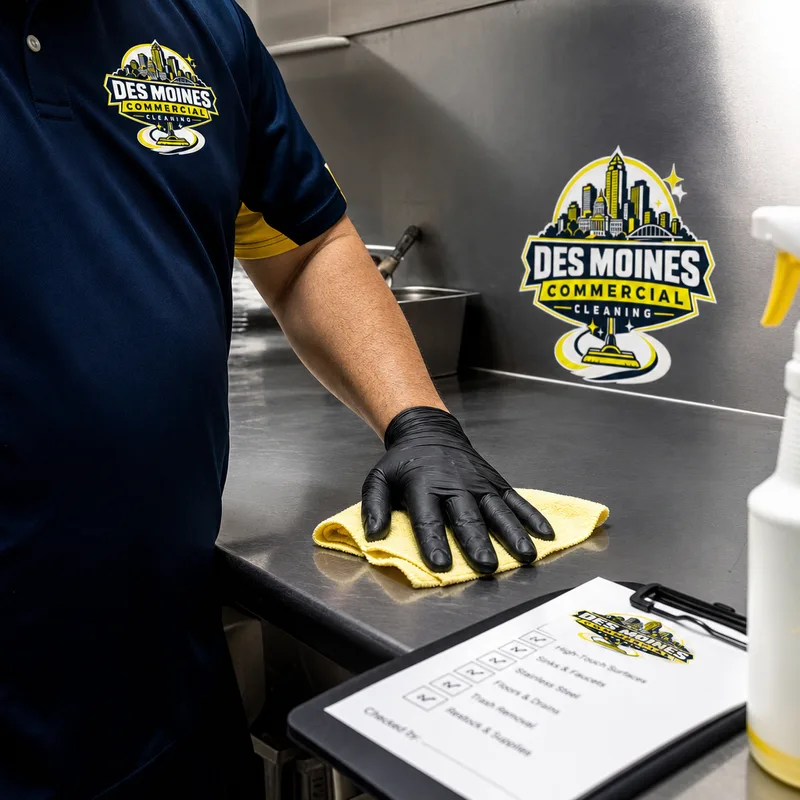
Technician wiping a stainless prep table and backsplash beside a cleaning checklist

Hours and peaks

Cleaning around retail hours

Retail hours leave a narrow window and a moving target. A store open until nine with a Saturday rush needs a different shape of service than a strip center tenant closing at six, and the holiday season changes both of them.

We handle post-construction cleanup for office buildouts and renovations across Des Moines, with scopes that typically include:

  • Overnight or pre-open service so the floor is reset before the first customer walks in.
  • Daytime porter coverage for entries, restrooms and spills through weekend peaks.
  • Added frequency from November through the holidays, then stepped back down in January.
  • Floor machine work and high dusting scheduled on closed hours or slow weeknights.
  • Remerchandising and reset nights supported with extra cleanup once fixtures have moved.

If the project is still active, we can coordinate around trades and target specific areas so you can open on schedule. For property managers and contractors, the goal is simple: the space should be clean enough for punch lists, walkthroughs, and move-in without rework.

For facility types that need heavier-duty protocols, the considerations overlap with industrial cleaning in Des Moines, especially around dust control and floor protection during turnover.

Request a Callback

Store budgets

How Much Does Retail Cleaning Cost in Des Moines?

Retail cleaning in Des Moines generally estimates out around $0.08 to $0.25 per square foot per visit. Large open sales floors sit at the low end because the area cleans quickly per square foot, while small stores carrying heavy touchpoint and restroom detail sit higher. A single storefront commonly lands near $250 to $900 per month at two to five visits a week, and an initial reset or periodic deep clean is usually estimated at $0.20 to $0.60 per square foot.

What moves the figure: open hours and visit frequency, customer count, restroom count, fitting room count, floor type and how much machine work it needs, back-of-house size, and whether you want daytime porter coverage. Shopping center common areas are quoted on the schedule they need rather than by area alone. Every number here is an estimate. Call 515 393 6898 for a walkthrough and a written quote on your space.

Request a Callback

Store manager answers

Questions from store and center managers in Des Moines

Can you clean while the store is open?

Some of it, yes. Entries, restrooms, glass, spills and trash all work fine during open hours and are usually better handled then, because that is when they get dirty. Floor machine work, fitting room detail and anything involving cords or wet floors belongs in a closed window, either overnight or before you open.

How do you keep the entry dry through an Iowa winter?

With matting and frequency rather than a stronger cleaner. Enough matting to absorb several footsteps, lifted and cleaned each visit so water is not trapped underneath, plus extra entry passes during a thaw. Salt film needs a neutral cleaner to release, which is why a store mopped with the wrong product all winter develops a permanent white haze.

Do you clean fitting rooms and mirrors?

Yes, and they are on the nightly list rather than a rotation. Fitting rooms are where a customer stands still, so the floor, bench, mirror and hooks all get looked at closely. We clear pins, tags and lint from corners, clean the mirror glass edge to edge, and wipe the bench and hook hardware every visit.

Can you add coverage for the holiday season?

Yes, and most stores need it from mid-November. Traffic roughly doubles, so the entry, restrooms and sales floor all need more frequent attention than they do in September. We write seasonal frequency into the scope ahead of time with a start and end date, so the budget is predictable and the step back down in January is automatic.

In a shopping center, who cleans common areas versus each store?

Usually two different contracts. The center ownership or property manager handles corridors, food court, common restrooms and vestibules, while each tenant handles its own space inside the lease line. We work either side, and when we hold both we keep the schedules aligned so the floor transition at a tenant entry does not end up as nobody's responsibility.

Do you clean the stockroom and the trash and recycling area?

Yes, if you scope it in, and it is worth doing. Receiving areas generate cardboard fiber and dust that migrate to the sales floor, and the trash staging area is where odor starts. We clean stockroom floors and aisles, the break room and the staging area. Compactor equipment itself stays with your facilities vendor.

Talk through your store

Get a cleaning plan built around your hours

Tell us your square footage, your open hours and whether you need daytime coverage, and we will walk the store at a busy time and put a split overnight and daytime scope in writing. Call 515 393 6898.

Request a quote

Tell us about your facility

Send the details and we will arrange a walkthrough, then follow up with a written scope and a price you can compare line by line.